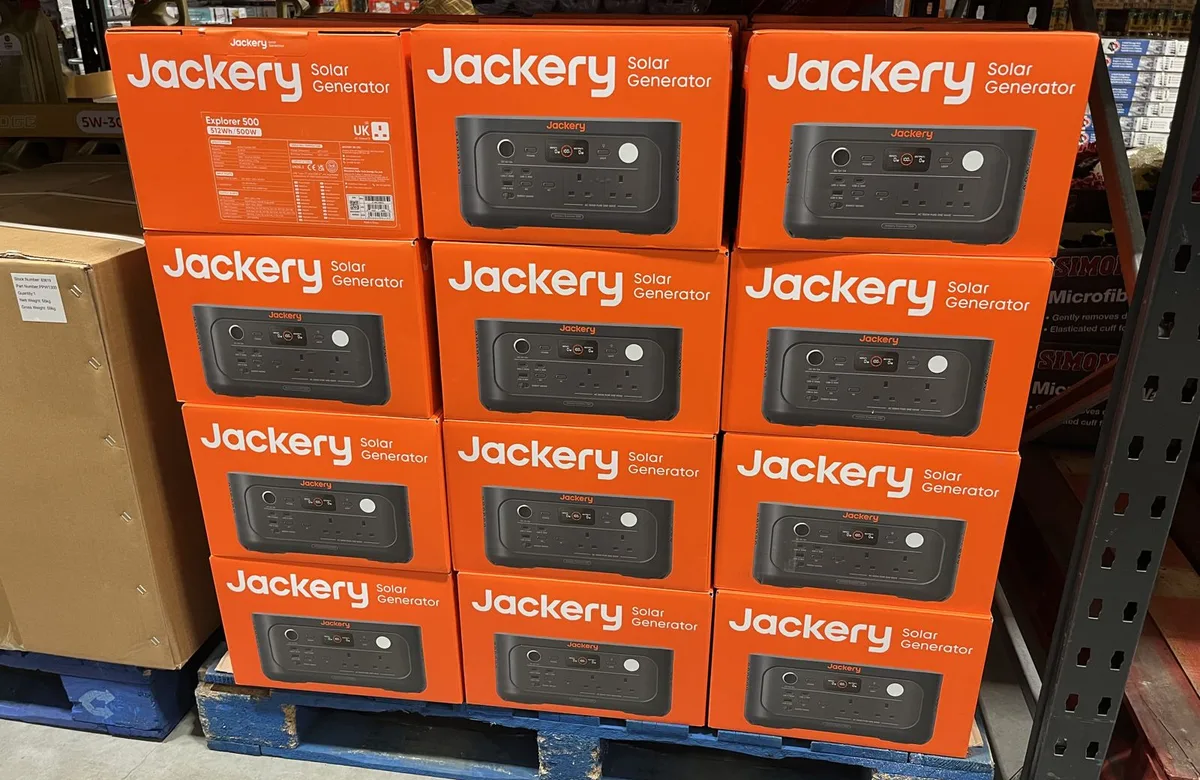
Jackery says up to 58% off and EcoFlow says up to 47%. I opened the product pages and wrote down what each one charged. Some prices match the adverts, some do not, and the kit that cuts your bill is not in the sale at all.
Two emails landed in my inbox this week, one from Jackery and one from EcoFlow, and both asked me to tell you about the biggest sale of the year. I earn a commission if you buy through the links on this page, so you should know that before you read another line. What I can offer in return is the part the emails leave out. I read every price below on the seller's own page on 14 November 2026, I compared it with what the email promised, and I have set out who each product is right for and who should keep their money.
You want a lower electricity bill. A power station does not do that. An approved plug-in solar kit does, from £336 for one panel and £456 for two, and none of them is in a Black Friday sale.
You want the lights and the phone on in a power cut, or power for a caravan or campsite. A 1 kWh power station is the right size for most homes, and this is where the sale prices are worth a look.
You want to use your daytime solar in the evening. That is a home battery, not a camping one. It takes a kit outside the plug-in rules, so budget for an electrician before you buy.
Jackery's campaign runs from 10 to 30 November 2026 and leads with new 2027 editions of its two best sellers. Its email to affiliates quotes £378 for the Explorer 1000 v2, £726 for the Explorer 2000 v2 and £1,352 for the Explorer 3000 v2. When I opened Jackery UK's own product pages on the evening of 14 November, two of those three prices were higher, and the page banner said up to 53% off, not 58%.
| Model | Size | Email price | Price on Jackery UK, 14 Nov | Cost per kWh stored | |
|---|---|---|---|---|---|
| Explorer 1000 v2, 2027 edition Pre-order, dispatch from 28 December | 1,024 Wh, 1,500 W | £378 | £419 | £409 | Latest price at Jackery UK |
| Explorer 1000 Plus v2 Expandable, in stock | 1,024 Wh, 1,800 W | £569 | from £569 | £556 | Latest price at Jackery UK |
| Explorer 2000 v2, 2027 edition Pre-order, ships from early December | 2,048 Wh, 2,200 W | £726 | £807 | £394 | Latest price at Jackery UK |
| Explorer 3000 v2 In stock | 3,072 Wh, 3,600 W | £1,352 | £1,499 | £488 | Latest price at Jackery UK |
Prices read at uk.jackery.com on 14 November 2026, VAT included. Cost per kWh is my arithmetic on the page price. Affiliate links.
The gap on the 2000 v2 and the 3000 v2 is almost exactly ten per cent, which suggests the email prices need a coupon or a member discount applied in the basket. I could not see that coupon on the product page, so I am quoting what the page charged. If the basket shows you the lower figure, good, and if it does not, you now know the email price was never the shelf price. Amazon UK listed the Explorer 2000 v2 at £726 and the 3000 v2 at £1,352 when I read it earlier the same day, so it is worth opening both before you pay.
Two more things I noticed on the page. The 2027 Explorer 1000 v2 is a pre-order with dispatch estimated from 28 December, so it will not arrive for a storm in early December. And the product page states a 30-day price guarantee, where the email says 60 days, so check the wording at checkout if a price promise matters to you.
EcoFlow's UK campaign runs from 13 November to the morning of 30 November 2026, with up to 47% off and a 30-day price match that covers orders placed on uk.ecoflow.com only. The larger savings on its sale page sit on RIVER models and panel bundles. Its two mainstream power stations showed no reduction when I read the page.
| Model | Size | Price on EcoFlow UK, 14 Nov | Shown as reduced from | |
|---|---|---|---|---|
| RIVER 3 Max | 572 Wh, 600 W | £438 | £598 | Latest price at EcoFlow UK |
| DELTA 3 Classic | 1,024 Wh, 1,800 W | from £499 | No reduction shown | Latest price at EcoFlow UK |
| DELTA 3 Max | 2,048 Wh, 2,400 W | from £1,199 | No reduction shown | Latest price at EcoFlow UK |
| STREAM AC Pro Home battery, not a camping unit | 1.92 kWh | £659 | See seller page | Latest price at EcoFlow UK |
Prices read at uk.ecoflow.com on 14 November 2026, VAT included. Some DELTA 3 models showed shipping from 21 December 2026, so check the dispatch date on the page. Affiliate links.
Bluetti sent no campaign details. Its current prices, read on the same day, are on the battery and power station page with the rest.
Here I am speculating, and I want to be clear that it is speculation. The government's emergency preparedness website asks every household to think about a power cut lasting a few days, and its list of things to keep at home includes a battery or wind-up torch, a battery or wind-up radio, spare batteries, a portable power bank for your phone and a backup battery for any medical equipment you rely on. In the same season, both brands are selling their power stations as winter blackout protection. One could argue the two are connected, since official advice makes people think about backup power and retailers follow the demand. I cannot show that one caused the other, and I would not put it more strongly than a coincidence of timing.
What I can say is that the weather gives the advice some weight. Storms Austen and Boelo arrived within a day of each other in late October 2026, and LBC reported, citing the Energy Networks Association, that more than 160,000 homes lost power at first and around 90,000 were still off at 7pm on Sunday 25 October. Most power cuts are over in hours. A few are not, and those are the ones people remember.
The numbers on the box are hard to picture, so here is my own arithmetic for a 1,024 Wh unit, assuming about 85% of the stored energy reaches your devices, which leaves roughly 870 Wh to use. These are estimates from typical power draws, not test results, and I have not tested any of these products.
| What you plug in | Typical draw | Roughly how long |
|---|---|---|
| Broadband router | 10 W | About three and a half days |
| LED lamp | 10 W | About three and a half days |
| Phone, full charge | 15 Wh each | More than 50 charges |
| Laptop | 60 W | About 14 hours |
| Fridge freezer | 40 W on average | Most of a day |
| Standard 3 kW kettle | 3,000 W | Will not run on a 1,500 W unit |
Two limits are worth knowing before you buy. A power station will not run your central heating, because most gas boilers need mains electricity and are wired into the house, as Citizens Advice points out in its power cut guidance. And you must never plug a power station into a wall socket to feed the house, since that can send electricity back into the network and put an engineer at risk. Plug appliances into the power station itself.
There is a reasonable case for buying now with March in mind, and it applies in two different ways. A power station bought this month is ready for the first camping trip, the caravan and the garden, and the pre-order models do not ship until December in any case. A solar panel is a different matter, because PVGIS-modelled output in a British December is a small fraction of what the same panel makes in June, so a kit bought today earns little until the days lengthen. The numbers for October to December are on my clocks-go-back piece.
That is why I would separate the two decisions. If lower bills are the aim, the product is an approved plug-in solar kit, and there is no sale to rush for. The cheapest two-panel kit on the ENA G98 register is £456, it pays back in about 3.7 years on my modelled saving of £124 a year, and buying it in February gives you the whole generating season. The cheapest approved kits are listed with the date each price was read, and I earn nothing on them.
If you are going to spend this month anyway, spend it on the product that matches the job. A power station bought for bill savings will disappoint, and a solar kit bought for power cuts will too, because an approved plug-in kit switches off when the grid goes down. That is a safety feature, and it is the reason the two products are not substitutes for each other.
If I wanted backup for this winter, I would buy a 1 kWh unit that is in stock, since a pre-order that ships after Christmas does not help in a December storm. On the prices I read, that points to the EcoFlow DELTA 3 Classic or the Jackery Explorer 1000 Plus v2, depending on the dispatch date shown on the day. If I could wait, the 2027 Explorer 1000 v2 is the cheapest per kWh of the 1 kWh units, and cheaper still if the basket gives you the email price.
Personally, I am keeping my solar money for the spring. The kit that lowers my bill costs the same in February as it does this week, and the sun does more for it then. Which of the three jobs are you buying for? If you are not sure, the postcode calculator will tell you what a panel would save at your address, and that is the number to settle first.
Free register alert
One hundred and forty-five kits from thirty-one manufacturers are now approved, and the list is changing week by week. I will email you when prices move or a major brand clears the register. One message, no noise.
No spam, unsubscribe any time. How we stay free.
See what a panel would save at your postcode before you spend on anything.